
There’s a line in your tenancy agreement that reads something like this: the tenant shall have the carpets professionally cleaned at the end of the term. It sits in a good half of the agreements I see across London. Most tenants read it and book a clean in a mild panic, without ever asking the one question that matters – whether the clause is worth anything at all.
It isn’t.
I fit and clean carpets for a living, so I’ll talk myself out of a job right at the top of this: the law does not make you hire me, or anyone like me, to get your deposit back. What the law asks of you is narrower than that clause pretends, and once you see the difference you’ll know when to pay a professional and when to keep your money in your pocket.
Does the law make you pay for professional cleaning?
No. In England the Tenant Fees Act 2019 put a stop to it.
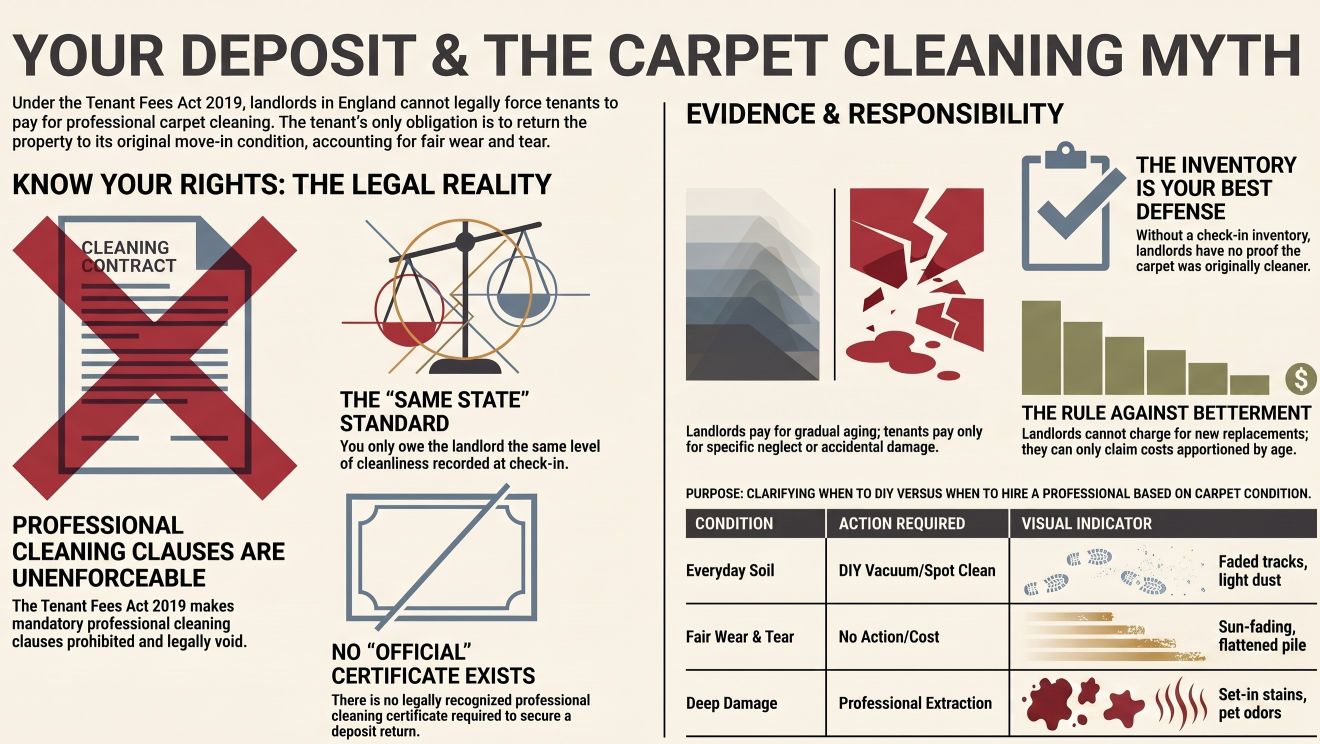
A blanket clause that requires you to pay for a professional clean – or to use one named company – is a prohibited payment under that Act, and a prohibited payment is unenforceable. The agent can print it in bold and have you initial the margin twice over; it still doesn’t bind you. What you owe your landlord is the property handed back in the same state of cleanliness it was given to you in, with fair wear and tear taken off. You can reach that standard any way you like – your own elbow grease, or any cleaner you fancy paying.
I fit carpets, I don’t practise law, so take the fine print to your deposit scheme if you want it confirmed. This part isn’t complicated, though, and every adjudicator in the country already knows it.
What “as clean as check-in” means
The whole thing turns on the check-in inventory. That’s the report – ideally with dated photographs – made the day you moved in, recording how clean each room was and what state the carpets were in. It’s the yardstick your check-out gets measured against. Carpets that were middling at check-in and middling when you left leave nothing to answer for. No inventory at all, and a landlord trying to bill you for cleaning has a steep hill to climb, because he’s nothing to show the carpet was any better the day you arrived.
So when can a landlord take money for carpet cleaning?
When you hand it back dirtier than you got it, past the point of fair wear and tear. That’s the only door left open to him, and it’s a fair one.
The line that causes every argument runs between fair wear and tear on one side and damage on the other. Fair wear and tear is the ordinary ageing of a carpet under normal use – the flattened, slightly greyed track worn down the middle of a hallway over three years, the gentle fading by a sunny window. You can’t be charged a penny for that. It’s the landlord’s cost of being in the business, and the deposit adjudicators are firm on the point.
Damage is a different animal. A red wine stain ground deep into the pile, or a scorch from a dropped iron – that’s yours to put right, and a reasonable cleaning or repair cost can come off your deposit.
One thing lands in your favour here, and it goes by the name of betterment. Your landlord can’t use your deposit to buy himself a brand-new carpet. If the carpet was already seven years old and tired, the most he can claim is the cost of dealing with the damage on a seven-year-old carpet, apportioned for the life it had left in it. A cheap builder’s-grade carpet is reckoned to last around ten years, so on a floor most of the way through that span, the sum a landlord can fairly recover is a good deal smaller than a full replacement invoice. New-for-old is off the table.
Where fair wear and tear ends and damage starts
The rough test the adjudicators reach for is whether a reasonable person would call it ordinary use or neglect. Muddy paw prints that vacuum and spot-clean straight out are one thing. A stain you let sit for six months until it set hard into the fibre is another, because the harm there came from doing nothing about it. If there’s a mark you’re unsure about, the honest move is to sort it before check-out rather than hope the report skims over it. Check-out reports don’t skim over much.
Does a professional clean and a receipt help your case?
It can. For one paragraph I’ll stop talking myself out of work.
Deposit disputes are won and lost on evidence. If it reaches the scheme’s free adjudication, the person deciding wasn’t in the flat and never will be – they see photographs and paperwork and nothing else. A dated professional cleaning receipt, sitting next to check-out photos of clean carpet, is tidy, believable proof that you returned the place as you should have. It closes the cleanliness argument before it opens.
A receipt has limits, and I won’t pretend it doesn’t. It proves the carpet was cleaned. It says nothing about damage, and it can’t un-spill the bleach that took the colour out of the bedroom floor. Pay me to clean a carpet with a permanent mark in it and you’ve got a clean carpet with a permanent mark in it – plus a receipt that quietly proves the mark was already there.
I did a check-out clean last year for a tenant leaving a flat on Mitcham Road in Tooting. Two faint cat stains near the window, nothing dramatic. The agent came back proposing to take most of the deposit for a whole new carpet. The tenant had the check-in report showing the carpet five years old and unremarkable on day one, my receipt, and clear photographs of every room. The scheme cut the claim down to a small apportioned cleaning cost and sent the rest of the deposit back. The paperwork did that, not the panic.
What a receipt does and doesn’t prove
Treat the receipt as one exhibit, not a magic ticket. It carries weight on cleanliness and none at all on damage. So if your only problem is that the carpets look tired and lived-in, a receipt is money spent proving a point nobody was going to win against you. If there’s real damage, a receipt won’t wish it away – you’re better off being straight about it and settling a fair, apportioned figure with the landlord directly.
When is a DIY clean enough on its own?
More often than my trade would like you to believe.
If the flat’s been lived in with a bit of care and the carpets are only carrying everyday soil, a proper vacuum and a go at the odd mark with a cloth and the right spot cleaner will pass a check-out without drama. You don’t need me for that, and I’ll talk myself out of the work by telling you so to your face. Half the end-of-tenancy flats I get booked for fall into exactly that bracket, with the tenant paying out of nerves rather than need. I turned down a studio in Kilburn a fortnight back – already vacuumed spotless, the tenant chasing a “professional certificate” the agent had demanded. No such certificate exists. There is no official document a cleaner can issue that a deposit scheme recognises, and any agent asking for one is either confused or hoping you are. I told her to keep her money.
Where it tips the other way is real staining and lingering smells. Pet accidents that have reached the underlay, or old spills that set months ago – those a supermarket hire machine tends to smear about and leave sodden rather than shift. A professional with proper extraction earns the fee there, and it’s the one situation where paying up front usually comes in cheaper than the deduction you’d otherwise cop.
The jobs a hire machine won’t finish
A hired machine is a blunt instrument. It lays down water and sucks some of it back, which is plenty for light soil. On a set-in stain it wets the carpet, lifts the top of the mark and leaves the rest to wick back up as it dries, so the stain you thought you’d beaten returns a shade fainter the next morning. Knowing which jobs sit beyond that machine is the whole skill, and it’s worth an honest phone call to someone before you hire one for a mark that was never going to come out.
What should you do before you hand back the keys?
Dig out the check-in report, walk the flat against it, and photograph anything that’s changed. That’s the whole job, and most people skip it.
Go carpet by carpet and be honest with yourself about which marks are wear and which are damage. Deal with the damage you can put right, and leave the fair wear well alone. Get dated photographs of everything on the day you go, and if a clean is worth doing, do it and file the receipt with the photos.
Then, if the agent leans on that unenforceable clause or floats a deduction you don’t recognise, ask for it in writing with the evidence behind it, and take it to the deposit scheme’s free adjudication if it won’t stand up. That service is there for exactly this, it costs you nothing, and the adjudicators see chancers every week of the year.
The document that wins most disputes
If you keep one thing from all this, keep the check-in inventory somewhere you can lay hands on it in two years. It’s the most useful piece of paper in the whole tenancy, and the one tenants most often bin in the first week. Without it you’re arguing from memory against a landlord’s file. With it, most cleaning deductions fold on sight.
The tenant on Mitcham Road kept theirs in a drawer for five years. It was worth more than any receipt I could have handed her.