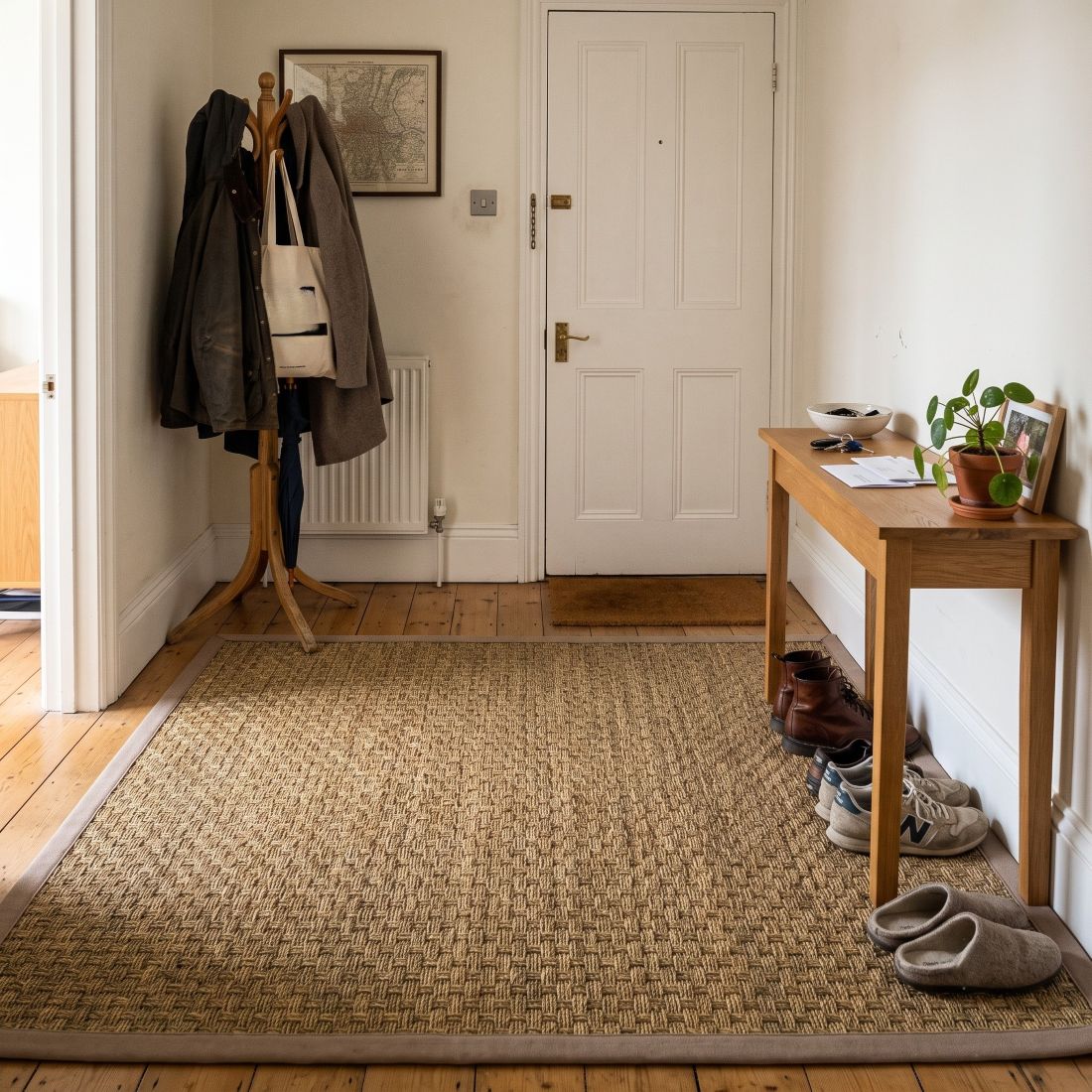
A seagrass floor looks like it can take anything. It’s the colour of dried grass and woven so tight you can barely get a fingernail between the strands, and the showroom will have told you it’s a hard-wearing natural fibre. So when something gets spilled, the instinct is to reach for the same treatment you’d give a wool carpet – a machine and hot water. That instinct wrecks more sisal and seagrass floors across Greater London than pets and shoes put together.
I get called out to these after the fact more often than I’d like. Someone has had a “professional clean” from a firm that treats every floor the same way, and now the seagrass runner up the stairs has gone wavy, or the sisal in the study has a brown ring the size of a dinner plate that wasn’t there a week ago. By then the floor stays ruined, and there’s little I can do beyond confirm it.
This is the one floor where the method matters more than the person holding the wand.
What happens when water hits a sisal weave?
Sisal is a plant fibre – agave leaf, spun and woven into cord. Like any plant fibre it drinks water and swells. Then it dries. As it dries it shrinks, and it doesn’t shrink back to where it started, so the weave distorts. On a fitted floor bonded to the boards that distortion has nowhere to escape to, and it lifts into ripples and hard ridges across the open middle of the room.
That’s the part people don’t expect. The fibre isn’t the weak point.
Why the backing fails before the fibre does
The backing is. Most fitted sisal and seagrass sits on a latex secondary backing, often over a jute scrim, and that whole sandwich is stuck down with the tension set on the day it was fitted. Soak it and the latex softens while the jute swells unevenly underneath. When it all dries out the tension has gone, the adhesive has released in patches, and the floor buckles. Once it buckles it stays buckled. You can’t re-stretch a natural fibre floor flat the way you’d re-tension a wool carpet, because the fibre carrying the weave has physically changed shape.
People assume that letting it dry slowly and gently will bring it back. It won’t. The damage is done in the drying, not the wetting – a slow dry just draws the buckling out over more days. And the tighter and better the original fit, the worse the buckle, because a well-fitted floor was under proper tension to start with and has more to lose when that tension lets go.
I lifted a seagrass floor from a garden flat off Thornhill Road in Barnsbury last spring where a cleaner had run a wet extraction machine across it to shift a coffee spill. The spill came out. The floor came up. It had rippled so badly along the join by the French doors that you caught your toe stepping through, and the owner was convinced a hot iron and a stack of books would settle it back down. That works on a cotton dhurrie. It does nothing for a woven grass floor that has already moved.
Why does seagrass watermark when sisal soaks it right up?
Two different problems, one cause.
Seagrass has a hard, waxy skin on each fibre. It’s grown half-submerged in paddy fields, and that near-waterproof outer coat is the reason you can’t dye the stuff and the reason a quickly blotted spill often does no harm at all. The trouble is what water does around the fibre rather than to it. Flood a seagrass floor and the moisture carries whatever is sitting in the backing and the fine dust in the weave out to the surface, then dries into a tide line – a hard brown edge marking exactly how far the wet patch crept. That mark stays brown. The same water that made it won’t lift it back out.
Sisal is the opposite character entirely. It’s thirsty. It pulls liquid straight in and holds it, so clean water left sitting too long soaks down to the backing and drags dye up from the underlay – discolouration arriving from below as well as from the spill on top.
The ring you’ll be looking at for years
Here’s the cruel bit about a watermark: the stain doesn’t form where the spill landed, it forms at the edge of wherever the wet spread to. A splash of water the size of a coaster can dry into a ring a foot wide. Which is why “just dabbing it with a damp cloth” so often makes a small problem into a large visible one, and why over the years I’ve stopped believing anyone who says a bit more water will even things out.
Is there ever a safe way to wet-clean natural fibre matting?
No. I’ll say it plainly and I won’t dress it up with caveats.
Every serious maker of these floors prints the same line on the care card. Alternative Flooring, Kersaint Cobb, the lot – dry clean only, never steam clean or wet-shampoo, because water saturation leaves you with shrinkage and staining you can’t undo. They’re not just covering their backs. They know precisely what their own fibre does when it gets wet.
Here’s where I annoy a few people in my own trade: a “natural fibre specialist” sticker on the side of a van means very little. There’s no real qualification sitting behind most of them. The technician I’d trust with a sisal floor is the one who tells you flatly he won’t put water through it, not the one waving a certificate about how carefully he can.
The proper way to freshen one of these floors is a dry compound – an absorbent powder worked through the weave with a brush and then vacuumed straight back out, no rinse and no extraction. Even the handful of people who mist a micro-splitting agent onto natural fibre keep the moisture down to a whisper and dry it hard behind them.
What the care card spells out
Read the label that came with the floor and it’ll tell you the same story I’m telling you. Blot spills the moment they happen, scrape solids off with a blunt edge, dry any damp patch fast with a hairdryer, and keep a machine well away from it. Regular vacuuming with strong brush-suction is all these floors need for day-to-day care; under no circumstances should the carpet be saturated, or you’ll get dimensional changes and staining from the dyes in the underlay. None of that is a marketing dodge. It’s the honest ceiling of what the material will tolerate.
Why can’t the damage be put right afterwards?
Because a fitted natural fibre floor is a single bonded object, not a set of pieces you can swap around.
You can’t cut out one buckled section and drop in a fresh square the way you’d patch a wool carpet from an offcut in the loft. The weave won’t line up and the shade won’t match, because these floors mellow with light and age from the day they go down. So a ripple in the middle of a Chiswick sitting room doesn’t mean a repair – it means relaying or replacing the whole run, and neither the material nor the fitting comes cheap. That’s a room emptied of furniture, the old floor cut out and binned, fresh gripper where it’s needed and a fitter back for the best part of a day. All of it because a spill the size of a saucer met the wrong machine.
Why a patch never blends in
And I’ll say the thing the flooring shops won’t. If you’ve got young children and you’ve had a sisal stair runner fitted, you bought the wrong floor. It’ll mark, it’ll stain, and it can’t be wet-cleaned – so the first knocked-over juice cup on the landing starts a problem no cleaner alive can reverse. It photographs beautifully. It’s a liability on a family staircase, and no amount of skilled aftercare changes that.
I had a call from a house near Wapping High Street where exactly this had happened. Lovely coir-and-sisal runner, two kids under five, and a set of stains marching down the treads that the owners had made worse each time they attacked one with a wet sponge. There was nothing to clean by then. There was only a floor to replace.
How should a sisal or seagrass floor be cleaned instead?
Vacuum it, and vacuum it properly. Strong suction, no beater bar – the beater achieves nothing on this weave and only frays the surface. Grit is what kills these floors, the fine stuff ground down into the pile underfoot over years, working like sandpaper on the fibre every time somebody crosses the room. Lift it out often and the floor lasts. Leave it in and no clean will bring back what the grinding has already worn off.
The one job that matters more than any deep clean
Deal with spills the second they land. White cloth or kitchen roll, and press rather than rub. Work from the outside of the mark inwards, then dry the spot fast with a hairdryer or a fan so nothing has the time to wick down into the backing. That single habit saves more sisal than any machine ever will.
When it does need a proper going-over, book someone who does dry compound work on natural fibre and who’ll tell you no to water without being asked twice. And keep these floors out of the rooms they were never meant for. Seagrass in a downstairs loo or hard against a kitchen sink is asking for trouble whatever the showroom claims about water resistance, because a waterproof skin on the fibre does nothing for the jute backing under a slow leak.
The seagrass off Thornhill Road went out in a skip. The floor that went down in its place was wool.